Editor’s Pick – Building bridges at De Meerpaal: A community-based living lab for co-designing technology involving people living with dementia
Brankaert. R., Bartholomeus, E., Tummers, A. and IJsselsteijn, W. (2025) ‘Building bridges at De Meerpaal: A community-based living lab for co-designing technology involving people living with dementia’ Journal of Dementia Care, 33(6) pp. 32-34
Rens Brankaert and colleagues from Eindhoven in the Netherlands describe a ‘Living Lab’ project where people living with dementia, their care partners, students, and researchers co-design technology together.
Every Wednesday afternoon, something remarkable happens at De Meerpaal community centre in Eindhoven’s Strijp district, in the Netherlands. People living with dementia and their care partners (family or friends) arrive for their weekly social gathering in their community. Regularly, they are joined by students and researchers from the Expertise Center for Dementia & Technology (ECDT) at Eindhoven University of Technology (TU/e). What unfolds in this partnership challenges conventional approaches to dementia research, demonstrating how genuine community partnerships can bridge the gap between academic research and lived experience.
The partnership emerged in 2014 between Trudy van Helmond, then chair of the local Catholic Seniors Association and now volunteer coordinator at De Meerpaal, and researcher Rens Brankaert during his studies for a PhD. When Brankaert joined TU/e’s faculty staff, focusing on working with and for people living with dementia, they saw an opportunity to create something meaningful in the community (Figure 1).
De Meerpaal itself represents resilience and community determination. The building was once derelict in a neighbourhood where many similar facilities had closed, but Trudy was determined to create a space where people who “don’t have it so easy” could gather for accessible activities. The organisation’s mission is based on bringing people together across the neighbourhood, stimulating initiative, self-reliance, and co-operation in social and cultural activities. Crucially, De Meerpaal is run by and for the neighbourhood, with all participants serving as volunteers.
Building bridges in practice
From 1pm-4pm every Wednesday, people living with dementia and their care partners from the community meet with TU/e researchers and students. They connect socially and develop projects together that promote quality of life through design and technology.
Summary
De Meerpaal community centre in Eindhoven, in the Netherlands, hosts a weekly ‘Living Lab’ where people living with dementia, their care partners, students, and researchers co-design technology together. This partnership between the Expertise Center for Dementia & Technology (ECDT) at Eindhoven University of Technology and a neighbourhood community centre demonstrates how genuine community partnerships
can bridge academic research and lived experience.
Every Wednesday afternoon, participants come together to have a social afternoon with fun activities. In addition, they engage in participatory design activities involving new technology that prioritise dignity and authentic feedback over traditional research outcomes.
The model succeeds through careful facilitation by “bridge-builders” who maintain trust and create safe spaces for joint experimentation.
This article describes the origins, methodology, and lessons learned from this collaboration, offering insights for practitioners seeking to establish similar community-embedded research initiatives that honour both innovation goals and human dignity.
This set-up requires careful balance between meaningful connection and resourceful input for research. Key people serve as “the glue”, or ‘bridge-builders’, between participants, researchers and students.
Trudy brings deep community knowledge and natural facilitation skills, while Ans Tummers-Heemels and Ellis Bartholomeus from ECDT provide research co-ordination and student guidance. Their role involves co-ordinating student projects, maintaining personal relationships with De Meerpaal participants, and coaching students in making appropriate contact. Participants carry lives full of stories they want to share, which deserve attention and care.
The facilitators remain flexible and prepared for various scenarios; they monitor appropriate care and attention for all.
Author Details
Rens Brankaert is professor at Tilburg University and Fontys UAS, and co-director of the Expertise Centre Dementia & Technology at TU Eindhoven, focused on designing warm technology with people living with dementia.
Ellis Bartholomeus is PhD candidate in Expertise Centre Dementia & Technology at TU Eindhoven, part of the QoLead project, focused on co-designing AI support tools with people with dementia.
Ans Tummers is expert on human touch research in dementia, and network liaison at Expertise Centre Dementia & Technology at TU Eindhoven.
Wijnand IJsselsteijn is professor of cognition and affect at TU Eindhoven in the Human Technology Interaction group, co-director of the Expertise Centre Dementia & Technology
Authentic engagement and feedback
Participants greatly enjoy these Wednesday afternoons with students and researchers. Together they engage in participatory design activities through a relational approach (Hendriks et al., 2014). They learn both indirectly through conversation and observation, and directly through more formal studies that collect data regarding a specific technology.
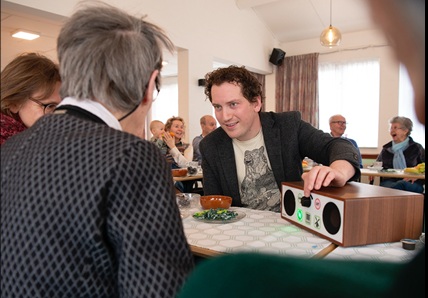
Participants provide remarkably candid responses to student projects. One striking example involved a participant telling a robot, “listen, you’re never coming into my house, just so you know!” (Figure 3). This honesty about concepts and products provides concrete, applicable input from authentic perspectives, which inspires students.
Students join at any stage of the design process, and consult the participants (Brankaert and Kenning, 2020). Sometimes participants are enthusiastic, though sometimes uncertain – and those responses are exactly what students need to move their projects forward. Rather than using complex research terminology, the process happens playfully and naturally.
To support this process, a preparation kit helps students understand several key elements:
- not everything goes as expected;
- keep written information brief;
- make interactions short and simple;
- avoid over-questioning;
- and, finally, to “subtract themselves” and take a person-centred approach – listening to people is more important than their own research goals.
The intergenerational exchange creates mutual benefits. Young and old meet each other, they learn from each other. Participants can observe how others handle ageing, illness, and limitations, learning different approaches to these challenges.
Underpinning principles
The work at De Meerpaal draws on the concept of ‘Warm Technology’, which challenges the dominant paradigm of designing technology primarily as a functional compensation for disability (IJsselsteijn et al., 2020). Instead, warm technology emphasises dignity, enjoyment, and relational value. The honest responses of participants reveal how authentic engagement provides feedback that is both critical and constructive, shaping technologies that are not only usable but also meaningful.
As a Living Lab, De Meerpaal integrates real-life contexts and co-creative processes to engage all relevant stakeholders (Bergvall-Kåreborn et al., 2009). Unlike controlled laboratory studies, Living Labs embed research in everyday environments, enabling authentic interaction, iterative design, and mutual learning (Brankaert and den Ouden, 2017). Crucially, Living Labs are not sites for “hit-and-run” research, where the only interaction with researchers involves formal data collection. They demand long-term commitment, trust-building, and careful facilitation to ensure participants feel safe, valued, and respected.
Equality, diversity and inclusion
De Meerpaal’s volunteer-run model ensures accessibility across socio-economic backgrounds, with all activities offered at low or no cost. The neighbourhood-based approach naturally includes diverse participants. Language barriers present ongoing challenges for non-Dutch speaking researchers or students, highlighting areas where inclusion practices continue to evolve.
Focus on lived experience
People living with dementia are central to every aspect of De Meerpaal’s activities. They are not research subjects but active design partners who shape technology development from initial concepts through to feedback on prototypes. Care partners also participate fully, contributing their perspectives and experiences. The Wednesday afternoon structure emerged from consultation with participants about timing, duration, and format that works best for them.
Key points
- Living Labs can bring benefits for everyone involved: important stakeholders such as researchers, students, universities, companies, people living with dementia, their care partners and dementia care organisations are involved in a ‘Living Labs’, and together derive benefits for their own goals from being involved.
- Bridge-builders are essential: trained facilitators who understand both research needs and lived experiences of people with dementia create trust and maintain a safe space weaving academic and community contexts.
- Participatory design principles at work: when people living with dementia are considered experts and active design partners rather than passive subjects, they provide authentic, constructive feedback that shapes meaningful technology.
- Community partnerships enable sustainability: long-term relationships between universities and community centres benefit all participants through mutual learning and intergenerational exchange.
- Flexibility matters more than protocols: preparing students to adapt their approach, listen attentively, and embrace uncertainty creates more meaningful engagement; rigid research methods come second.
- Living Labs requires commitment: successful community-embedded research demands consistent presence, reflection, trust-building, and reciprocity. Living Labs require engagement with participants that goes beyond one-off data collection.
Lessons learned
The bridge-builder role is essential: people who know participants well and for a long time, and understand their backgrounds. They create trust through being suitable key figures who ensure a positive atmosphere and safety, while connecting participants to researchers and students.
Flexibility and responsiveness matter more than rigid protocols. The philosophy centres on experimentation, looking at what is possible and not assuming it can’t be done, while keeping feet firmly grounded in reality and improvising when needed.
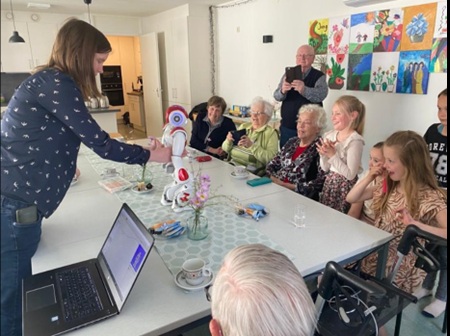
Managing expectations requires honesty and transparency about research limitations: not all projects will succeed; not all products can reach the market. Giving people space to be themselves, being open to possibilities while understanding limitations, creates authentic engagement.
Challenges and future development
Structural continuity needs attention, particularly incorporating student participation schedules throughout the academic year. The model’s future depends on institutional commitment and finding individuals who can serve the crucial bridge-building role.
The success at De Meerpaal has inspired replication.
A new Living Lab location in Waalre, south of Eindhoven, has been established where people live together, some with dementia and others with different support needs.
Looking ahead, De Meerpaal seeks to maintain its essential character while expanding its impact. This will include more interaction, inviting previous participants to return with their stories, and creating a better balance between new and experienced students.
Conclusion
De Meerpaal offers more than a research setting – it is a community where people living with dementia remain central to innovation processes affecting their lives. The model succeeds because it prioritises relationships over outcomes, process over products, and mutual learning over one-sided data collection.
As Trudy’s guiding principle states: “Alone you can do much; together you can do everything!” For practitioners considering similar initiatives, the message remains clear: give people space, embrace the possibility that things may go wrong, and allow participants to be who they are. “Here at De Meerpaal I am someone. People see me” (Jack – a member of De Meerpaal).
References
Bergvall-Kåreborn, B., Holst, M. and Ståhlbröst, A. (2009) ‘Concept design with a living lab approach’, Proceedings of the 42nd Hawaii International Conference on System Sciences. Available at: https://doi.org/10.1109/HICSS.2009.123
Brankaert, R. and Den Ouden, E. (2017) ‘The design-driven living lab: A new approach to exploring solutions to complex societal challenges’, Technology Innovation Management Review, 7(1), pp. 44-51. Available at: https://doi.org/10.22215/timreview/1049
Brankaert, R. and Kenning, G.(2020) HCI and Design in the Context of Dementia. Springer, pp. 1-15. Available at: https://doi.org/10.1007/978-3-030-32835-1_1
Hendriks, N., Slegers, K. and Wilkinson, A. (2014) ‘Challenges in doing participatory design with people with dementia’, Proceedings of the 13th Participatory Design Conference, 1-4. Available at: https://doi.org/10.1145/2662155.2662196
IJsselsteijn, W., Tummers-Heemels, A. and Brankaert, R. (2020) ‘Warm technology: A novel perspective on design for and with people living with dementia’. In R. Brankaert and G. Kenning (eds) HCI and Design in the Context of Dementia. Springer, pp. 33-48. Available at: https://doi.org/10.1007/978-3-030-32835-1_3