
How do people with dementia use technology in their everyday lives?
Astell, A., Awan, H., Pearson, D., Venkatesh, R. and Wilkins, E. (2025) ‘How do people with dementia use technology in their everyday lives?’, Journal of Dementia Care, 33(6) pp. 18-20
Professor Arlene Astell and trainees describe a research project conducted at the University of Reading and Northumbria University that used ‘home technology tours’ to explore what tech people with dementia used in their own homes.

There are not many technologies made especially for people living with dementia. Products such as tablets and voice assistants can do things that are helpful for people with and without cognitive impairment. For example, storing telephone numbers, keeping track of appointments, and giving calendar reminders. We set out to explore what technologies people living with dementia use and what they use them for.
Home Technology Tours
To find out about technologies people use in their daily lives, we use an approach called Home Technology Tours (Astell, et al., 2016; McGrath, et al., 2019). Researchers visit people at home where they are guided around by the resident. As they go around the home, the residents point out technologies they use in their everyday lives. This can include televisions, cookers, mobility aids or medication reminders.
Digital devices such as smart phones, tablets and voice assistants (e.g. Alexa) can also be included. As they go round their homes the residents are asked to describe what technologies they use in each room, what they use them for, and how they acquired them. After going round the home, we sit down with the residents so they can tell us anything else they want to say about their use of technology. We ask permission to audio-record the tours and the interview at the end. Afterwards we transcribe the audio recordings and identify themes in their tours.
Thirteen people living with memory difficulties or dementia diagnoses kindly agreed to invite us into their homes. The eight men and five women lived in the South-West, South-East and North-East of England. They were aged between 71- 88 years, with an average age of 78 years.
Key points
- Home technology tours led by people with
dementia are an important way of learning
what tech people use and what they use it for. - People with dementia use a wide range of
tech, including digital devices, for a variety of
purposes, including practical assistance in
their house, staying connected with family and
friends, mental stimulation, and pleasure. - People with dementia can learn to use new
technologies that help them maintain
independence but tech design needs to take
into account cognitive impairments. - If technology is imposed on people with
dementia, even with good intent, without
engaging with them and explaining it first, they
may never learn how to use it or see any
benefit it has.
What technologies were used
More than 40 individual tools were used by the people who gave home tours. These fell into four groups. Examples of each group of technologies can be found in Table 1 below.
Everyone had a phone, with many having both a landline and a mobile phone. People also used desktop computers or tablets such as iPads, while some used both. Alexa and WhatsApp were also popular with more than half of the home tour ‘guides’. Instagram, Candy Crush (digital game) and ProCreate art app were also being used.
What technologies were used for
Technologies were used for three main reasons: maintaining independence; maintaining enjoyable activities; and, staying connected.
| Low tech | Household appliances | Assistive devices | Digital tools |
| Notice board, diary, wall calendar, family planner | TV, cooker, vacuum cleaner, landline telephone, washing machine, kettle | Electric bath chair, panic alarm, electric wheelchair | Desktop computer, iPad, Alexa, social media, smart phone, digital apps |
Maintaining independence
Using technology to stay at home and keep looking after themselves was mentioned in different ways. For example, one person explained how both she and her husband had mobility difficulties, and their electric bath chair enabled them to stay at home:
” I don’t think I could lift my legs over on my own anymore. So yes, it, you know, you press a button and it gets you in and out, which is great.” [SW4]
Another person with mobility difficulties summed up the importance of their electric wheelchair to their daily life:
“It helps me go out. I can get fresh air and not become very tired by walking. Without my chair, I wouldn’t be able to go out anywhere.” [SW5]
One person living with dementia and hearing loss described how digital technology supports their independence as follows:
“Actually it’s [Ring doorbell] connected to my hearing aid so I can use it to answer the door.” [SE1]
In addition to the specific activities detailed above, people also described various strategies they used for everyday memory support. This individual used a hybrid solution combining a low-tech device (white board) with a high-tech one (smartphone):
“The board, yeah definitely…[Interviewer: Is there anything else you use for remembering?] Just putting a reminder on my phone.” [NE1]
Maintaining activities
Using technology to keep up activities was an important motivation for many people. Cooking, for instance, is a daily activity that many people strive to maintain. One person reported using their Alexa:
“I spend a lot of my time in here [kitchen]. I love to cook. It makes sense having it [Alexa] in here when I use it for recipes and music.” [SW3]
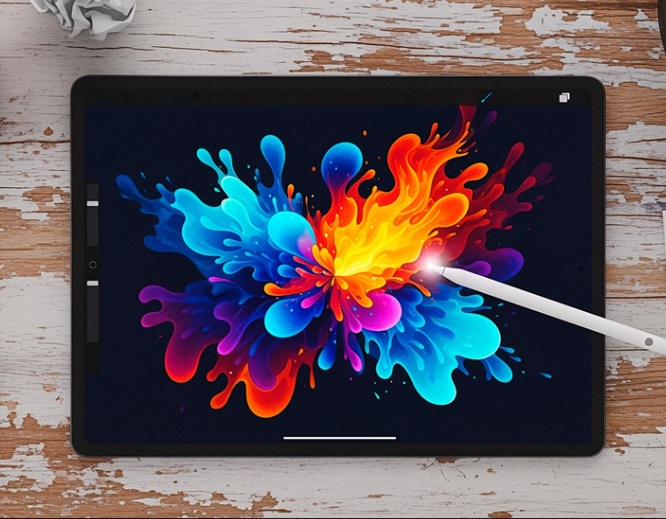
Another person who had worked as an abstract artist, used ‘ProCreate’, to overcome physical barriers to painting, due to frailty. ProCreate is an app you can use to create digital art pieces from photographs on your camera (see example in Figure 1). She explained:
“I use it for taking photographs and using ProCreate, which is the thing like, well, it’s an art programme for me to do my art on. I can’t paint so much now. My hands are frail. This helps me to still do my art.” [SW1]
Other apps used for meaningful activity included playing digital games such as “Candy Crush”, a digital colour and shape matching game. Many people also reported more traditional leisure activities such as watching television and listening to the radio. While some people described these activities as “relaxing”, others linked keeping up with the news and other TV programmes with mental stimulation.
For example:
“I like documentaries, movies, anything really that helps me to think about things, or just to relax.” [SE2]
While this person said:
“I have a radio in the corner…BBC Radio 4. I listen to it every morning. It’s an intellectual station. I listen to the news every morning. Good to know what’s happening. They have lots of talks and it helps me to keep my mind active and stay up to date with the world.” [SE3]
Staying connected
Social interactions with family and friends were another important role for technology. WhatsApp in particular, is popular as it allows people to do many things in one app: video call, text, share photographs and videos. For example, one person described how it enables them to keep in touch with family in a different country:
“As a family we use WhatsApp all the time. I mean I sit down and talk to my daughter in Spain on WhatsApp…What’s great about it is we can get three families on at the same time.” [NE1]
Another person described the advantages of video-calling over landlines and mobiles:
“Yeah, with mine, when the family phone me we do video ‘cause it’s easier to lip read. I’ve got the hearing aid but even with the hearing aid sometimes I miss out, but you know I’ve got to see a person’s mouth, so they video call.” [NE3]
In addition to independence, activities and staying connected, people made decisions about adopting technologies based on how easy they were to use. Some people found voice assistants (e.g. Alexa) simple, for example:
“I mean, they’re very easy to use. You know, you just speak to them and they kind of do whatever you need to do really.”[SW4]
Others had difficulties, suggesting they needed more assistance in setting these devices up and learning how to use them:
“This is what my daughter bought me, she uses it all the time, Alexa” [Interviewer: You don’t use it?] Nah, I don’t use it; I’m terrified I’ve pressed the button by mistake, ha.” [NE1]
Similar concerns were reported about other devices, often provided by family members that people living with dementia had not learned to use on their own or did not see a benefit. For instance:
“My son he sets us up with everything. We don’t use technology either, apart from phone. But my son, he does our online banking, and he orders our online shopping if we need it. He will send us a message.” [SE4]
Safety was another factor that came up in describing the reasons people use technologies in their everyday lives. Many people carried a mobile phone when they were out, for example:
“The phone is with me in case of emergencies, but I don’t really use it.” [SE1]
Another person described how wearing a panic bracelet made them feel safe:
“It helps me do things on my own and not worry as much.” [SW4].
Author Details
Professor Arlene Astell is Professor of Cyberpsychology at the Northumbria University Newcastle, and has worked with people living with dementia in clinical and research settings for over 30 years.
Hira Awan has a Master’s degree in Psychology from the University of Reading and is currently a Rehabilitation Therapy Assistant in the NHS. Danielle Pearson has a Master’s degree in Psychology from the University of Reading and is currently a Graduate Entry Medical Student at the University of Warwick.
Rahul Venkatesh has a Master’s degree in Dementia Studies from Stirling University and is currently a PhD student at Northumbria University supervised by Professor Astell.
Elisha Wilkins graduated from Northumbria University in July 2025 with a BSc Psychology.
Conclusions
People living with dementia use technologies in their everyday lives for the benefits they give them. They demonstrated a range of low technology tools, household appliances, assistive technology and digital products on the home technology tours. The mix of technologies provide support that people want and need to keep doing the things that are important to them.
Remaining independent was highlighted on the tours, with people describing how different technologies support them. Examples included being able to continue cooking or dealing with physical problems such as mobility challenges. A mixture of digital and low technology memory aids also helped people remain independent by planning out their day and reminding them of things they needed to do. Maintaining meaningful activities also contributed to independence, as people used technology to keep doing things they enjoyed, such as art. Leisure activities such as games, TV and art were also supported by different forms of technology. Unsurprisingly, staying connected was another important role for technology, with people using a mixture of phones and video-calling to keep in touch with family and friends.
These findings challenge misconceptions that people living with dementia do not wish to use ‘new’ technologies. Continuing to use household appliances, as well as adopting digital consumer products such as tablets and voice assistants, challenges stigma around the abilities of people living with dementia to learn new technologies. As with any new device, there is a learning curve and behaviour change is required to adopt a new technology into our lives. The cognitive demands of adopting a new device may be greater for people living with dementia but the rewards can be very beneficial. We hope that this work inspires both awareness-raising of existing devices and functionality, and increased development of new technologies to meet the specific needs, desires and priorities of people living with dementia.
References
Astell, A.J., Hwang, F., Williams, E.A., Archer, L., Harney-Levine, S., Wright, D. and Ellis, M. (2016) ‘Wellbeing and HCI in later life – what matters?’, Human Interface and the Management of Information: Applications and Services, Part II, pp. 445-453.
Maguire, M. (2001) ‘Methods to support human-centred design’, International Journal of Human-Computer Studies, 55, pp. 687-634.
McGrath, C., Molinaro, M.L., Sheldrake, E.J., Laliberte Rudman, D., and Astell, A.J. (2019) ‘A protocol paper on the preservation of identity: Understanding the technology adoption patterns of older adults with age-related vision loss (ARVL)’, Journal of Qualitative Methods, 18, pp. 1-8.